|
|
Permission to Reprint: You may reprint any items from The Leader Letter in your own printed publication or e-newsletter as long as you include this paragraph:
"Reprinted with permission from The Leader Letter, Jim Clemmer's free e-newsletter. For over twenty-five years, Jim's 2,000+ practical leadership presentations and workshops/retreats, six bestselling books, columns, and newsletters have been helping hundreds of thousands of people worldwide. His web site is www.clemmer.net." |
 |
|
|
|
|
|
After about the fifth revamp of our web site since we first began a web site in 1996, we've found - once again - that web site makeovers are like home renovations; they take twice as long as expected and cost twice as much. We're finally very pleased to announce a complete update and overhaul of our web site. Either www.clemmer.net or www.jimclemmer.com will get you there.
I am obviously more than a little biased here, but in the spirit of continuous improvement, Aidan Crawford - our web master, writer, publicist, home renovator, Marketing Director and all around nice guy - keeps making our site better and better. The biggest trick he has pulled off is taking what's become a huge site (over 900 pages!) and making the layout cleaner and site navigation simpler.
Drop on by and have a good long look around. We hope you'll find its worth far more than the price of admission! If you do notice any problems - no matter how minor - or have continuous improvement suggestions to make the site even better, please e-mail either of us at [email protected] or [email protected]. |
| Key Features of Our Revamped Web Site |
|
| |
|
We've made lots of changes and improvements. Here are the main ones:
Re-Indexed Articles -- We spent the better part of the summer rethinking how we could organize the articles on the site. Under our new system all my articles are now filed by common or popular subject areas under four simple categories. This will make it easier than ever to find the resources you need when you need them. And when you get to an article, you can now leave your feedback right on the page with our new comment feature.
Introductory Video Clips -- To personalize and provide an overview of our main sections, you'll find optional - short - video clips I have recorded for a personal tour. It's a great way for visitors - new and old - to become familiar with all the resources available to them.
Integrated Blog -- We've upgraded our blogging software. And as of this week we will transfer all our feeds from blogger to our new blog located here - jimclemmer.com/blog.
Take a Leadership Quiz -- You'll find ten leadership quizzes right on the home page of the site. They are fun and functional as you can track how well you're doing as a leader and get suggestions on how to improve yourself, your team or your organization!
As you go through the site you'll see hundreds of minor tweaks that should make jimclemmer.com your first stop when you need practical leadership resources.
|
| Thoughts that Make You Go Hmmmm...on Continuous Improvement | |
| |
"The road to success is always under construction."
- Author Unknown
"In the long run, we shape our lives, and we shape ourselves. The process never ends until we die. And the choices we make are ultimately our own responsibility."
- Eleanor Roosevelt, American diplomat, writer, US First Lady
"Business is like a man rowing a boat upstream. He has no choice; he must go ahead or he will go back."
- Lewis E. Pierson, early 20th century American business leader
"It is not necessary for a business to grow bigger; but it is necessary that it constantly grow better."
- Peter Drucker, The Essential Drucker
"Yesterday's home run won't win tomorrow's ballgames."
- Babe Ruth, Baseball player, AKA The Great Bambino, The Sultan of Swat, and The Home Run King
"It is not the strongest of the species that survives, nor the most intelligent; it is the one that is most adaptable to change."
- Charles Darwin, English naturalist and author of the landmark book On the Origin of Species
"Without cultivating a pliant mind, our outlook becomes brittle and our relationship to the world becomes characterized by fear. But by adopting a flexible, malleable approach to life, we can maintain our composure even in the most restless and turbulent conditions. It is through our efforts to achieve a flexible mind that we can nurture the resiliency of the human spirit."
- The Dalai Lama and Howard C. Cutler, The Art of Happiness: A Handbook for Living
"When you're finished changing, you're finished."
- Benjamin Franklin, One of the "founding fathers" of the United States
|
| iPhone. uPhone. We all scream for iPhone |
|
| |
|
With over four million 3G iPhones sold since it's release in June, and the game changing nature of the iPhone's App Store, I'm very proud to announce that the first business books for this powerful little device will be mine!
In association with Appengines.com, I'm releasing all my books as individual apps for the iPhone. Just last week, Moose on the Table was released and is selling briskly at the very reasonable price of $4.99.
As I write this we are already developing interactive iPhone versions of Growing the Distance and The Leader's Digest, combining each book with the associated planner and guide to allow readers to take and store quizzes right on their phone!
Integrating quizzes and exercises will make these powerful leadership resources "must-have" additions for every professional using an iPhone.
To view a demo of how Moose on the Table will look on the iPhone go to:
http://www.jimclemmer.com/content/view/964 |
| Elections Re-Focus Us on Leadership | |
| |
|
With elections in full swing this month across Canada and the United States, the question of what makes a leader great has come up more now than at any time in the next four years. Winston Churchill, Lester B. Pearson and Franklin D. Roosevelt are often cited as examples of great leaders.
After thirty years of researching, writing about, teaching, and trying to apply leadership I have found there are some differences, but many more similarities, between those who successfully lead teams or organizations and those who lead nations.
Here are three characteristics that are shared by strong leaders at every level of any organization - whether a private or public institution:
Leaders are About Action
A central theme in my work is that leadership is an action, not a position. Because someone has been appointed to a leadership role they are called a leader. But many people in leadership roles aren't leaders. They might be vice presidents, CEOs, managers, administrators, department heads, directors, or even "snoopervisors" - but they're not leaders. Too many "appointed leaders" sit back and wait rather than taking the initiative and making things happen. In other words, they don't provide leadership through their actions.
Here are three short articles around this theme (click on the titles to read):
Leaders Inspire by Example
Great leaders have long understood the empathetic importance of a heartfelt gesture, no matter how insignificant it might seem on the surface. On a rainy day in 1943 a battalion was lined up waiting for an inspection by Lord Mountbatten. The officers wore raincoats, but the troops had none. They were soaked. Mountbatten's car pulled up and he emerged wearing a raincoat. After taking a few steps, he turned around and went back to the car to shed his raincoat. He then turned to make the inspection. The troops cheered.
One of the greatest soldiers of all time knew how inspirational strong leadership can be in the most difficult of times.
Here are three short articles around this theme (click the titles to read):
Strong Leaders are Strong Communicators
With few exceptions, highly effective leaders have very strong communication skills. They connect with people. Since leadership deals with emotions, energy, and spirit, verbal communication skills have a huge role to play in mobilizing and energizing. No matter how "right" a vision, deeply held principles, or purpose may be, they won't mobilize others if they can't be effectively communicated.
Highly effective leaders transfer their energy and passion to the people they're trying to mobilize with words that paint exciting pictures, ring true, fire the imagination, or touch the spirit. Like the leader, their words are charged with energy.
Here are three short articles around this theme (click the titles to read):
|
| Using Strategic Imperatives to Drive Team/Organization Development | |
| |
A huge problem with many planning activities is that management teams invest a lot of time and effort in setting their key objectives and goals for the coming year (often as part of their budgeting process) only to follow through on those plans like many of us follow through on New Year's resolutions. It's a confusion of good intentions with actually changing habits and doing something differently to get different results.
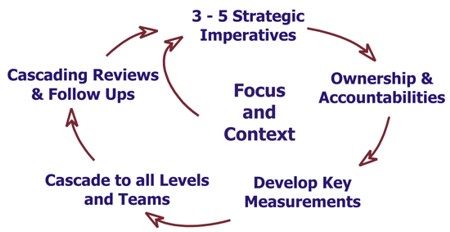
Following management team retreats, our consulting and training group has had a lot of success using Strategic Imperative Teams to move plans forward with effective follow - through and action. It starts with identifying Strategic Imperatives and then cascading these through every part of a department, division, or entire organization.
This diagram gives a high level overview of the typical flow. It starts at the centre with the management establishing, reaffirming, or revitalizing their Vision, Values, and Purpose (Focus and Context).
A Strategic Imperative is an initiative, key project, or major objective that is systemic (strategic) and a must-do (imperative) over the next six to twelve months to significantly move a team/organization toward its vision and desired culture.
- Our process for implementing Strategic Imperatives is to form teams for each imperative using this template:
- Executive sponsor/owner
- Team leader
- Possible team members
- Team mandate/charter
- Timelines/stages
- Once the teams are set and their mandate/charter agreed to by the larger executive or steering team overseeing this work, each Strategic Imperative Team then develops and manages:
- Development of a detailed implementation plan
- Execution
Later in Chapter Ten and onward through the rest of Moose on the Table I tried to illustrate how the central character, Pete Leonard used the Strategic Imperatives Team approach to bring about transformational change in his department. If you've read the book, you can see a short video clip of me explaining the rationale for Chapter Ten at http://www.mooseonthetable.com/leadership-videos.html (scroll down and click on the Chapter Ten screen shot). |
|
|
| Bolt-On Programs or Built-In Culture Change | |
| |
|
Some people collect stamps. Others collect model trains. I collect studies. And over the past three decades I've collected hundreds of studies that show fifty to seventy percent of service/quality improvement, reengineering, introduction of new technologies, mergers/acquisitions, re-structuring, team building, and so on either fail or sputter pretty badly.
The main cause of those failures is a partial and piecemeal effort. Too many of these initiatives have a limited scope - disconnected from the rest of the organization.
This chart shows the critical differences between a narrow and management-based approach to change and a systemic leadership-based approach.
| Bolt-On Programs |
Built-In Culture Change |
|
Training/change programs delegated to internal/external experts and specialists. |
Organizational/behavior change led by line managers. |
|
Departmental initiatives (like HR, IT, financial, marketing, customer service) planned and managed independently. |
Integration, interdependence, and interconnections across departments, programs, and initiatives. |
|
Regularly renewing and re-launching change and improvement programs as previous ones die out. |
Discipline of follow-through and follow-up with two-way accountability, learning, and continuous improvement. |
| Electronic monologues push out an ever growing amount of top down and departmental data and e-mails. |
Electronic tools support the many lively dialogues/conversations up, down, and across the organization. |
| Vision/mission statements and core values have a high "snicker factor" and little day-to-day use. |
Vision, mission, and values actively guide decisions for strategy, planning, hiring, coaching, recognition, training, promotions, etc. |
|
Crisis management to fix the problem or figure out who to blame. |
Tracing root causes to the bigger systemic issues. |
| Measurements and performance discussions are painful distractions from "getting my work done." |
Frequent and transparent measurements and feedback guide collective learning, decision making, and change. |
| Processes and organizational systems are internally focused, fragmented, and managed by specialists and experts. |
Processes and organizational systems serve external customers with integrated support for frontline teams across a chain of internal partnerships. |
|
| Consulting Corner :
What Impacts Organization Culture? | |
| |
|
Our Senior Vice President, Scott Schweyer, has been successfully leading our consulting and training "boutique" of specialists and experts at The CLEMMER Group since early in this decade. In all my years leading The Achieve Group/Zenger Miller and now The CLEMMER Group, I have worked with dozens of consultants. Scott is exceptionally strong in his intuitive ability to help Clients make the changes that need to happen in order to dramatically shift their culture toward higher effectiveness.
Culture change has become a major initiative for many of our ongoing consulting and training Clients. So in this issue, Scott begins a regular "Consulting Corner" column with an introductory piece on what we've found impacts organization culture. Click here to read it.
In future issues, Scott will continue sharing his insights with examples and how-to advice for leading culture change. |
| Moose on the Table Review Dashes My Hopes of a Literary Prize! | |
| |
|
As you can read in Emily's review of my latest book, Moose on the Table: A Novel Approach to Communications @ Work, she doesn't feel I'll be getting a call from the Nobel or Pulitzer prize judges any time soon. But - as she so perceptively picked up - high brow fiction wasn't the point of Pete Leonard's (the book's fictional and central character) leadership adventures.
"Over the last couple of years I've become very familiar with the concept of eating your frog/toad in a time management kind of way, and have been coming to terms with eating elephants (a bite at a time if you're dealing with project management). Now, in the words of the woman on my yoga video, "we've got another animal on our hands." This time it's a moose, but thankfully we don't have to eat it. Any other animals we need in a business context?
Moose on the Table by Jim Clemmer has the subtitle 'A Novel Approach to Communications @ Work'. I didn't realise until I started reading it that that is exactly what it is - a novel. What a fun way to approach a serious subject! It's the story of how Pete sorts out a frighteningly bad leadership problem to turn the company he works for around. It's a nice, easy read with a lot to take away and apply to your own situation. I certainly know a lot more about leadership (and moose) than I did before.
To be honest, if I had sat down to read this as a novel rather than a business book then I may have come away a bit disappointed. As far as a work of fiction goes it's probably not the best bit of writing I've ever read. But that's not the point is it? As a refreshingly different approach to providing advice on leadership and communications this is a huge success. It certainly ticks all the boxes of being easy to read and conveying the information in an easy to absorb way.
If you're interested in learning more about good (and bad) leadership or have an in-house issue you need to tackle this would be a good place to start."
Posted by Emily on her United Kingdom web site "Brilliant Business Books - and other ramblings of a small business owner."
|
| Most Popular September Improvement Points | |
| |
|
Improvement Points is a free service providing a key thought or quotation from one of my articles, provided three times per week, directly to your e-mail inbox. Each complimentary Improvement Point links directly into the full article on our web site that spawned it. If you'd like to read more about that day's Improvement Point, you can choose to click through to the short article for a quick five-minute read. This is your opportunity for a short pause that refreshes, is an inspirational vitamin, or a quick performance boost. You can circulate especially relevant or timely articles or Improvement Points to your team, Clients, or colleagues for further discussion or action.
Here are the three most popular Improvement Points we sent out in September:
"Effective systems follow, serve, and support rather than control, direct, and dictate. The central structure and systems alignment question is "for whose convenience is your organization designed?" Is it to serve customers and those producing for or serving them? Or is it designed to make life easier for management and staff support groups?"
- from Jim Clemmer's article, "Systems and Structure Pathways and Pitfalls"
Read the full article now!
http://jimclemmer.com/content/view/203/9/
"If the reason for a company's existence is just profit, they won't be very profitable. Eventually the company probably won't even exist. The dollar sign isn't a cause. It doesn't stir the soul. Operating margins and returns on investment don't excite and inspire. As an ultimate objective on its own, the pursuit of profits is hollow and unsatisfying. Such naked greed is one-dimensional. It comes from, and leads to, the naked selfishness of 'what's in it for me?'"
- from Jim Clemmer's article, "The Purpose - Profit Paradox"
Read the full article now!
http://jimclemmer.com/content/view/449/31/
"Most organizations only talk about customer service improvement. Many executives don't understand what outstanding customer service really looks like, aren't ready to turn their organization inside out to provide it, are trying to paint happy smiles on their frontline service providers, or are bolting a customer service program on the side of their organization rather than making it a part of their core strategy."
- from Jim Clemmer's article, "Blocks to Customer Focus"
Read the full article now!
http://jimclemmer.com/content/view/128/31/
|
|
|
|
I am always delighted to hear from readers of The Leader Letter with feedback, reflections, suggestions, or differing points of view. Nobody is ever identified in The Leader Letter without their permission.
I am also happy to explore customized, in-house adaptations of any of my material for your team or organization. Drop me an e-mail at [email protected].
Keep learning, laughing, loving, and leading - living life just for the L of it!!
Jim |
|
Please post or forward this newsletter to colleagues, Clients, or associates you think might be interested - or on a 'need-to-grow' basis. If you received this newsletter from someone else, and would like to subscribe, click here: http://jimclemmer.com/content/view/745
The CLEMMER Group
10 Pioneer Drive, Suite 105, Kitchener, ON N2P 2A4
Phone: (519) 748-1044 ~ Fax: (519) 748-5813
E-mail: [email protected]
http://www.clemmer.net
Copyright © 2008 Jim Clemmer and The CLEMMER Group | | |